

As the new Critical Role season builds steam, preparing for the concluding part of its opening act and splitting the cast members into three separate groups, viewers are continuing to learn more about the enigmatic realm of Aramán, crafted by game master Brennan Lee Mulligan. The previous setting, the universe of earlier campaigns, relied heavily on well-known D&D lore. However, one of the most exciting elements of Campaign 4 is how Mulligan plays with those familiar references to create something truly original.
A New Take on Angelic and Fiendish Beings
Fans have already encountered Aramán’s sad and twisted interpretation of the heavenly beings, but the third installment, titled “The Snipping of Shears,” also provides some background about their demonic opposites, the demons. This label has been used quite generically in Campaign 4, but the intriguing part is that it also includes individuals that would be categorized as “tieflings” in other D&D settings, including the fiendish spellcaster Tyranny, played by Whitney Moore.
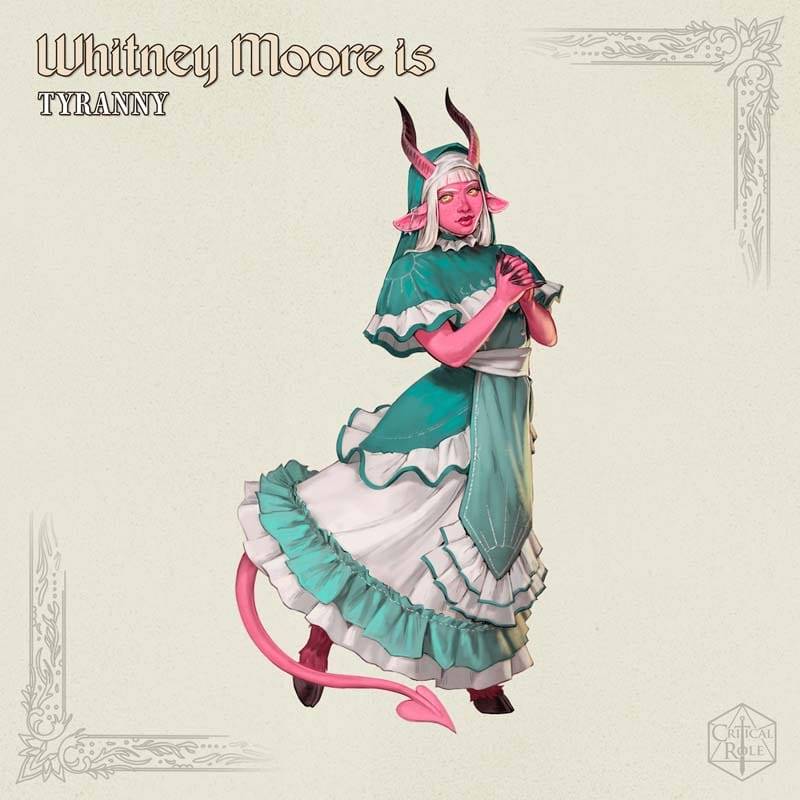
Historically, tieflings are mortals with Fiend ancestry, but it appears that in Aramán, they’re actual fiends whose essences have come to inhabit a physical form as the outcome of a deal. In the latest episode, it was revealed that these entities dwell in a place called the Pit, governed by an sinister entity called the Shadow of Suffering. Ksha'aravi made an agreement with House Halovar, in which he would supply them demons to use as agents and as paragons of redemption for the a religious order. As payment, he would get mortal souls and some of the a mystical substance, a substance with divine properties created by the Halovars.
Understanding the New Lore
If you find all this puzzling, many share your confusion. The Dungeon Master is a expert at hinting, and he’s being meticulous about how much he discloses in each episode. Still, it’s reasonable to infer from what we know that Aramán’s tieflings are infernal spirits who occupy a physical form. This is an interesting twist on one popular D&D character species, and one with the capacity to make it more engaging.
The History of The Fiend-Touched
The origin of this race dates back to 1994 and the famous Planescape Campaign Setting for second edition AD&D. They were loosely defined as humans with otherworldly heritage, implying it originated from infernal beings, chaotic fiends, or other malevolent entities. Planescape author the designer explained afterwards that he left the tieflings' origins vague on purposefully because he aimed to create an character type for a reformed devil/antihero persona, in part to appeal to the gothic and emo mindsets. Third and fourth edition D&D, though, further defined and narrowed down those backgrounds (a decision that the creator criticized), resulting in the widely accepted view that these beings all have ancestry that traces back to the Lower Planes.

Although the specifics about that ancestry vary greatly, the common point is that tieflings are humans with the blood of Fiends running through their veins. In the game, Fiends are the inhabitants of the Lower Planes of malevolent nature, including the Abyss, the Nine Hells, Carceri, the fiery pit, the maddening chaos, and probably a few more that are often overlooked. This cosmology is shared among almost all D&D settings, even the previous campaign setting, which has had its fair share of demonic encounters. While these evil creatures are native to the Lower Planes, they can be called forth to the mortal world or access it through portals. They arrive with their corporeal forms, but they can only be truly slain on their native planes.
Breaking with Convention
The description of the infernal domain and its denizens made in episode 3 of Campaign 4 steers away from these standard features. The High Prince strongly resembles Asmodeus, the ruler of the Nine Hells, with all that plotting and soul bargaining, but my impression is that the fiends in this world do not have a solid form, or at least one they can use to enter the “mortal realm” (or whatever its name is in the setting). Tyranny specifically says in episode 3 that she was “given a body” just half a year prior, and before that she was just a “swirling soul” in the infernal abyss, so this appears to be the beginnings of tieflings in this new setting (upcoming installments may show traditional tieflings do appear, but considering that this character is a player character, this is unlikely).
The Creator’s Intent
Going back to the designer’s comments, he stated that he designed the race to fill a particular niche: the afflicted, quasi-damned protagonist, that didn’t exist in D&D's epic fantasy-focused roster of options at the time. Planescape co-author Colin McComb said in the same interview that "These characters appeal because they're brooding and intense. They've got an automatic built-in secret. They're outsiders and loners, and they have a valid cause to shun society (and be shunned by it).” With time, though, the gloom that was baked into the origin of tieflings faded away, and they evolved into a highly favored character option with additional magical abilities and a cool, different look.
Returning to the Edge
There’s nothing wrong with that. You can portray a cheerful fiend-blooded character who never contemplates about their fiendish bloodline, if that’s what you like. However, I think that this new interpretation excels exactly because it doubles down on that “evil” origin, turning it into a core aspect of the persona. In every way, Tyranny and her sisters have a body only because of Ksha'aravi’s dealings with the Halovars. When she has the inevitable emancipation arc, breaking free from the shackles of her infernal kin, it will seem impactful and intense because her race’s background is baked into the setting’s lore.
Looking Ahead
In addition to this fresh perspective at tieflings, I’m also curious to learn more about the Pit and Aramán demons. I’m a big nerd for the game’s universe structure, especially the mythology of the infernal dimensions. I could read about strife in the Nine Hells, fights among fiendish rulers, and the mysterious origins of the neutral fiends all day. Yet, this lore is more or less consistent in most fantasy worlds, so there is anticipation for some fresh, significant expansion to it.


